Introduction
loud computing has transformed the way businesses build and scale applications. At the heart of this transformation is the powerful and highly distributed AWS Global Infrastructure provided by Amazon Web Services (AWS).
Understanding AWS Global Infrastructure including Regions, Availability Zones (AZs), and Edge Locations is essential for architects, developers, and businesses designing secure, scalable, and highly available cloud solutions. The strength of AWS Global Infrastructure lies in its globally distributed design, built to deliver resilience, performance, and fault tolerance at scale.
In this guide, we’ll break down AWS Global Infrastructure in a simple, practical way so you can clearly understand how it powers modern cloud applications worldwide.
AWS Global Infrastructure?
AWS Global Infrastructure is the worldwide network of data centers that powers AWS cloud services. It is designed to deliver:
-
- High availability
- Fault tolerance
- Low latency
- Global scalability
- Strong security and compliance
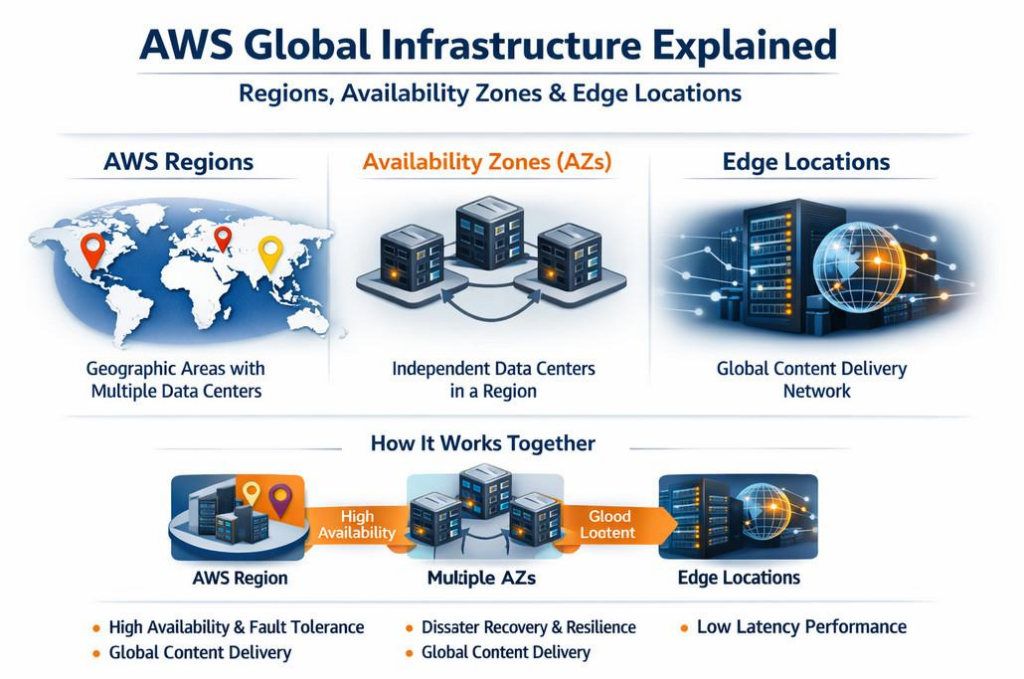
The infrastructure is divided into three major components:
-
- Regions
- Availability Zones (AZs)
- Edge Locations
Let’s explore each one in detail.
AWS Regions
An AWS Region is a geographical area that contains multiple isolated data centers.
Each Region is physically separated from other Regions to ensure independence and fault isolation. For example:
-
- US East (N. Virginia)
- Asia Pacific (Mumbai)
- Europe (Frankfurt)
Key Characteristics of AWS Regions
-
- Each Region contains multiple Availability Zones
- Data does not leave a Region unless explicitly configured
- Designed for high fault tolerance
- Allows deployment close to users for lower latency
Why Choose the Right AWS Region?
Selecting the correct Region depends on:
-
- Latency requirements (closer to users = faster performance)
- Compliance and data residency laws
- Pricing differences
- Service availability
For example, if your primary users are in India, choosing Asia Pacific (Mumbai) reduces latency compared to deploying in North America.
Availability Zones (AZs)
An Availability Zone (AZ) is one or more discrete data centers within an AWS Region.
Each AZ:
-
- Has independent power, cooling, and networking
- Is physically separated from other AZs
- Is connected via high-speed, low-latency links
Why Availability Zones Matter
AZs are the foundation of High Availability (HA) in AWS.
By deploying applications across multiple AZs, you can:
-
- Prevent single points of failure
- Achieve automatic failover
- Increase uptime and resilience
For example:
-
- Deploy EC2 instances in multiple AZs
- Use a Load Balancer to distribute traffic
- Store database replicas in different AZs
If one AZ fails, the application continues running in another AZ.
Edge Locations
Edge Locations are part of AWS’s global Content Delivery Network (CDN) system, primarily powered by Amazon CloudFront.
Unlike Regions and AZs, Edge Locations are not full data centers. Instead, they cache content closer to end users.
What Do Edge Locations Do?
-
- Deliver cached content (images, videos, APIs)
- Reduce latency
- Improve website performance
- Enhance user experience globally
For example:
If your application is hosted in Asia Pacific (Mumbai), but users are accessing it from Europe, CloudFront serves cached content from the nearest Edge Location in Europe dramatically improving performance.
How Regions, AZs, and Edge Locations Work Together
Here’s how AWS Global Infrastructure components interact:
-
- Regions → Provide geographic isolation
- Availability Zones → Provide high availability within a Region
- Edge Locations → Deliver content globally with low latency
Example Architecture
-
- Application hosted in Asia Pacific (Mumbai) Region
- Deployed across 2–3 Availability Zones
- Static content distributed using Amazon CloudFront
- Global users served from nearest Edge Location
This setup ensures:
-
- High availability
- Disaster resilience
- Low latency
- Global scalability
Benefits of AWS Global Infrastructure
-
- Fault isolation and disaster recovery
- Enterprise-grade security
- Compliance-ready architecture
- Global performance optimization
- Scalable infrastructure on demand
AWS continuously expands its infrastructure footprint to support growing global demand.
Best Practices When Designing on AWS
-
- Deploy workloads across multiple AZs
- Use Auto Scaling for elasticity
- Enable CloudFront for global content delivery
- Choose Regions based on user proximity
- Design for failure (assume infrastructure components can fail)
Conclusion
Understanding AWS Global Infrastructure is fundamental for designing secure, resilient, and high-performing cloud architectures.
By properly leveraging Regions, Availability Zones, and Edge Locations, you can build applications that are:
-
- Highly available
- Fault tolerant
- Globally scalable
- Optimized for performance
Whether you’re preparing for AWS certifications, designing enterprise workloads, or starting your cloud journey, mastering these core infrastructure concepts is essential.
Check out our detailed blog on IAM Roles vs Policies vs Users.
What’s Next?
We’re here to support you! Should you have any questions or need assistance, don’t hesitate to get in touch with us. Contact us at info@uranuscloudsolutions.com and we’ll be happy to help. Your satisfaction is our priority!.