Introduction
Modern cloud applications are distributed, dynamic, and highly scalable. With microservices, containers, and serverless architectures, troubleshooting performance issues has become more complex than ever. This is where Observability on AWS plays a critical role.
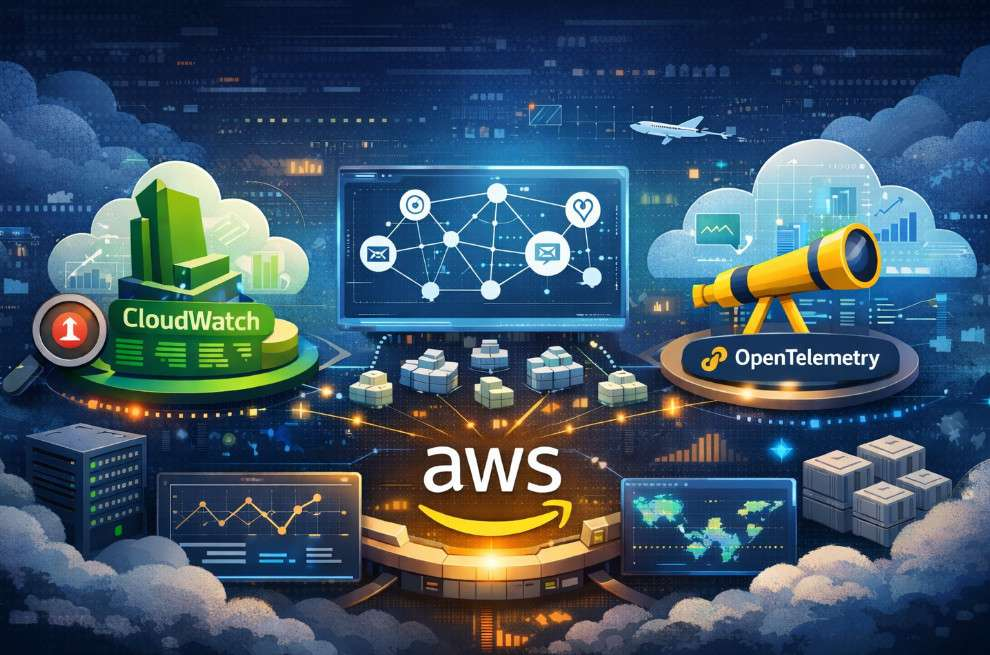
By using Amazon CloudWatch, AWS X-Ray, and OpenTelemetry, organizations can gain deep visibility into system performance, application behavior, and infrastructure health.
In this guide, we will explore how to build a strong observability strategy using AWS native and open source tools.
What Is Observability in AWS?
Observability is the ability to understand what is happening inside your system by analyzing the data it produces.
It is built on three pillars:
- Metrics – Performance measurements like CPU usage, latency, and error rates
- Logs – Event records generated by applications and services
- Traces – End-to-end request tracking across distributed systems
A strong Observability on AWS strategy combines all three pillars to provide complete operational visibility.
Amazon CloudWatch: Monitoring and Log Management
Amazon CloudWatch is the foundation of monitoring in AWS environments.
Key Capabilities
- Real time infrastructure monitoring
- Centralized log collection
- Custom dashboards
- Automated alarms and notifications
CloudWatch helps teams detect anomalies, monitor resource utilization, and automate responses to operational events.
When to Use CloudWatch
- Infrastructure level monitoring
- Log aggregation
- Alert configuration
- Performance dashboards
AWS X-Ray: Distributed Tracing for Microservices
AWS X-Ray helps developers analyze and debug distributed applications.
What X-Ray Provides
- End to end request tracing
- Service dependency maps
- Latency analysis
- Root cause identification
For applications running on Lambda, ECS, EKS, or EC2, X-Ray provides detailed insights into how services interact and where delays occur.
OpenTelemetry on AWS: Standardized Instrumentation
OpenTelemetry (OTel) is an open-source observability framework supported by AWS.
Why Use OpenTelemetry?
- Vendor neutral instrumentation
- Multi cloud compatibility
- Unified metrics, logs, and traces
- Future proof architecture
OpenTelemetry integrates with CloudWatch, X-Ray, Prometheus, and third party monitoring tools.
For organizations operating in hybrid or multi-cloud environments, OpenTelemetry strengthens Observability on AWS while maintaining flexibility.
How These Tools Work Together
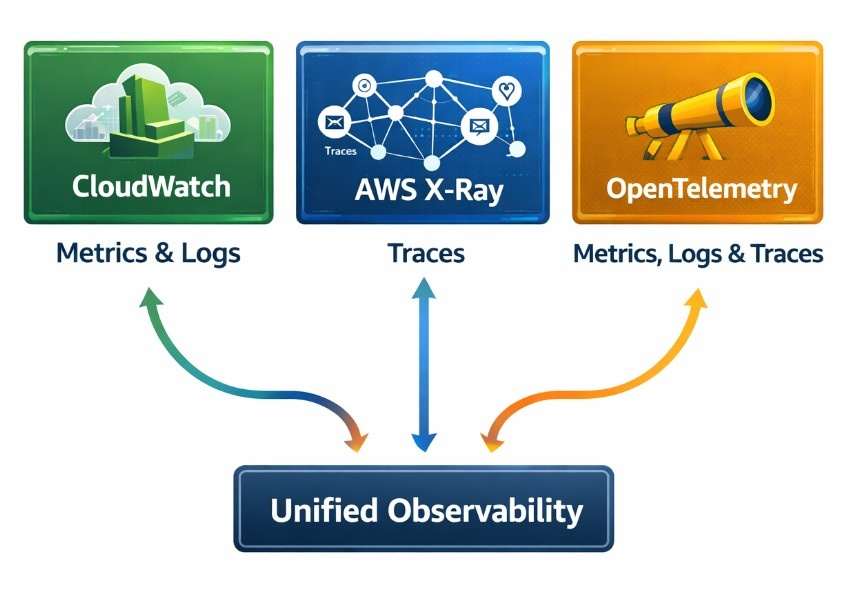
A complete observability setup often includes:
- CloudWatch for metrics and logs
- X-Ray for distributed tracing
- OpenTelemetry for standardized data collection
Together, they create a unified observability layer that improves visibility, troubleshooting speed, and system reliability.
Best Practices for Observability on AWS
- Enable structured logging
- Set meaningful alert thresholds
- Correlate metrics with traces
- Use dashboards for business level visibility
- Regularly review performance trends
An effective Observability on AWS implementation reduces downtime and accelerates incident resolution.
Benefits of Observability in Cloud Environments
- Faster root cause analysis
- Improved application performance
- Reduced operational risk
- Better user experience
- Scalable monitoring strategy
As cloud systems grow, observability becomes a strategic advantage rather than just a monitoring function.
Conclusion
Implementing Observability on AWS is essential for modern cloud-native applications. By leveraging CloudWatch for monitoring, X-Ray for tracing, and OpenTelemetry for standardized instrumentation, teams gain deep insights into system behavior.
As cloud architectures continue to evolve, building a strong observability foundation ensures improved reliability, better performance, and long term scalability.
Check out our detailed blog on Designing a Scalable Cloud Architecture.
What’s Next?
We’re here to support you! Should you have any questions or need assistance, don’t hesitate to get in touch with us. Contact us at info@uranuscloudsolutions.com and we’ll be happy to help. Your satisfaction is our priority!.