Introduction
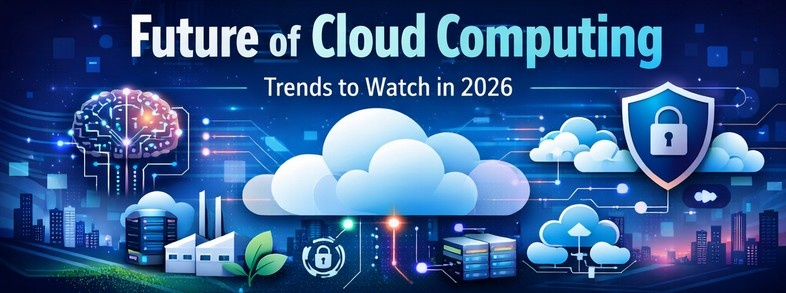
The Future of Cloud Computing is entering a new phase where intelligence, automation, and sustainability define modern IT strategies. As we move toward 2026, cloud platforms are evolving beyond infrastructure to become strategic enablers of business growth, innovation, and resilience.
Organizations that understand upcoming cloud trends will be better positioned to scale efficiently, control costs, and maintain strong security postures.
In this blog, we will cover the key cloud computing trends shaping 2026, including AI native platforms, multi cloud strategies, serverless computing, cloud security, and sustainable cloud adoption.
1) AI Native Cloud Platforms
Artificial intelligence is now deeply embedded into cloud platforms. The Future of Cloud Computing will be driven by AI native services that automate operations, optimize performance, and reduce human intervention.
Key capabilities:
- Predictive autoscaling
- AI driven monitoring and alerting
- Automated incident remediation
- Intelligent DevOps workflows
2) Multi Cloud and Hybrid Cloud as Standard Architecture
By 2026, multi cloud and hybrid cloud strategies will no longer be optional. Enterprises are adopting distributed architectures to improve resilience, avoid vendor lock in, and meet regulatory requirements. This shift is a defining element of the Future of Cloud Computing.
Benefits:
- Improved availability and disaster recovery
- Flexible workload placement
- Regulatory compliance
- Cost optimization
3) Serverless Computing for Enterprise Workloads
Serverless computing continues to mature, supporting complex and business critical applications. The Future of Cloud Computing will see serverless become the default choice for event-driven and microservices architectures.
Advancements include:
- Reduced cold-start latency
- Improved observability
- Stronger security controls
- Enterprise grade governance
4) Zero Trust Cloud Security
Cloud security in 2026 will be built on Zero Trust principles. Identity first access, continuous verification, and least privilege policies will define how organizations secure cloud environments in the Future of Cloud Computing.
Zero Trust essentials:
- Continuous authentication
- Identity aware access control
- End to end encryption
- AI based threat detection
5) Sustainable and Green Cloud Computing
Sustainability is now a core cloud decision factor. The Future of Cloud Computing includes carbon-aware workloads, energy efficient infrastructure, and transparent sustainability metrics.
What to expect:
- Green data centers
- Carbon reporting dashboards
- Energy optimized architectures
- Sustainability driven cloud selection
6) Edge Computing and Distributed Cloud
Edge computing is converging with cloud platforms to enable real time processing for IoT, healthcare, smart cities, and 5G applications. This cloud to edge model reduces latency and enhances performance for data intensive workloads.
7) Cloud Cost Optimization Through Automation
Rising cloud costs demand automated governance. In 2026, FinOps tools powered by AI will manage budgets, forecast spending, and enforce cost policies automatically.
Conclusion
The Future of Cloud Computing in 2026 is intelligent, distributed, secure, and sustainable. Organizations that embrace AI native platforms, automated cost controls, and Zero Trust security will gain a competitive edge in the digital economy.
Check out our detailed blog on Why Automation Is Critical for Cloud Cost Optimization?
What’s Next?
We’re here to support you! Should you have any questions or need assistance, don’t hesitate to get in touch with us. Contact us at info@uranuscloudsolutions.com and we’ll be happy to help. Your satisfaction is our priority!.