Introduction
When it comes to managing Azure infrastructure at scale, Infrastructure as Code (IaC) is no longer optional. Among the many tools available, the most common question Azure engineers ask is: Terraform vs Bicep vs ARM Templates which is the right choice?
Understanding the differences between Terraform vs Bicep vs ARM Templates is critical for building secure, scalable, and automated Azure environments. While all three tools enable Infrastructure as Code on Azure, they differ in syntax, scope, ecosystem, and long-term strategy.
In this blog, we provide a deep comparison of Terraform vs Bicep vs ARM Templates, helping you decide which IaC tool best fits your Azure workloads.
What Is Infrastructure as Code (IaC)?
Infrastructure as Code on Azure allows teams to define cloud resources using declarative templates instead of manual configuration. Tools like Terraform, Bicep, and ARM Templates enable repeatable deployments, version control, and CI/CD automation.
Choosing between Terraform vs Bicep vs ARM Templates directly impacts how efficiently your Azure infrastructure is managed.
Key Benefits of IaC on Azure
- Consistent and repeatable deployments
- Faster provisioning and automation
- Reduced human error
- Version control and change tracking
- Seamless CI/CD integration
Azure natively supports IaC through ARM Templates and Bicep, while Terraform offers a multi-cloud alternative.
Overview of Azure IaC Tools
ARM Templates (Azure Resource Manager)
ARM Templates are Azure’s original native IaC solution. They use JSON and interact directly with Azure Resource Manager.
While powerful, ARM Templates are verbose and harder to maintain, which is why the Terraform vs Bicep vs ARM Templates discussion often highlights ARM’s complexity.
Key Characteristics
- Native Azure support
- Declarative JSON format
- Deep integration with Azure Resource Manager
- Steep learning curve due to verbose syntax
Bicep
Bicep is Microsoft’s modern alternative to ARM Templates. It simplifies Azure-native IaC while compiling directly into ARM JSON.
In the Terraform vs Bicep vs ARM Templates comparison, Bicep stands out for readability and ease of use for Azure-only teams.
Key Characteristics
- Clean, readable syntax
- Native Azure support
- Built-in validation and tooling
- No state file required
Terraform
Terraform is a cloud-agnostic Infrastructure as Code tool widely adopted across enterprises.
In the Terraform vs Bicep vs ARM Templates debate, Terraform dominates when multi cloud or hybrid cloud support is required.
Key Characteristics
- Multi cloud and hybrid support
- Uses HCL (HashiCorp Configuration Language)
- Requires state management
- Large ecosystem and community
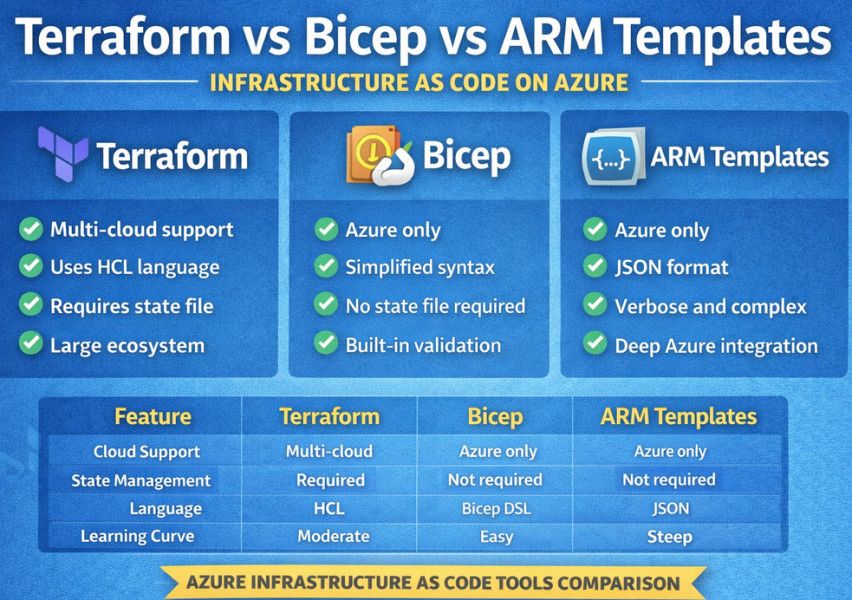
Terraform vs Bicep vs ARM Templates: Feature Comparison
| Feature | Terraform | Bicep | ARM Templates |
|---|---|---|---|
| Cloud Support | Multi-cloud | Azure only | Azure only |
| Language | HCL | Bicep DSL | JSON |
| Learning Curve | Moderate | Easy | Steep |
| State Management | Required | Not required | Not required |
| Azure Native | No | Yes | Yes |
| Reusability | Modules | Modules | Nested templates |
| Tooling Support | Excellent | Excellent | Limited |
| CI/CD Integration | Strong | Strong | Strong |
Terraform on Azure: Pros and Cons
Advantages
- Ideal for multi cloud strategies
- Strong module ecosystem
- Mature state management
- Works well with complex enterprise architectures
Limitations
- Requires managing Terraform state
- Not Azure-native
- Some Azure features lag behind ARM/Bicep support
Best Use Case
Organizations managing Azure + AWS/GCP, or teams already standardized on Terraform.
Bicep on Azure: Pros and Cons
Advantages
- Simplified syntax compared to ARM Templates
- Azure-native and officially supported
- No external state file
- Seamless integration with Azure CLI and DevOps
Limitations
- Azure-only
- Smaller ecosystem compared to Terraform
Best Use Case
Teams focused entirely on Azure Infrastructure as Code with modern tooling and simplicity.
ARM Templates: Pros and Cons
Advantages
- Direct access to all Azure features
- No additional tooling required
- Deeply integrated with Azure Resource Manager
Limitations
- Verbose and hard to maintain
- Poor readability
- Slower development velocity
Best Use Case:
Legacy Azure projects or scenarios requiring low level Azure control.
Which IaC Tool Should You Choose for Azure?
Terraform is suitable when:
- Your infrastructure spans multi cloud or hybrid environments
- Access to a large ecosystem of reusable modules is important
- Terraform is already adopted by your team
Bicep works best when:
- All workloads are hosted on Azure
- Clean and readable Infrastructure as Code is a priority
- Native Azure tooling is preferred without managing state files
ARM Templates are ideal when:
- You are maintaining legacy Azure deployments
- Full control over Azure Resource Manager is required
- Existing automation is already built using ARM Templates
Terraform vs Bicep: The Real World Azure Decision
In modern Azure projects, Bicep is rapidly replacing ARM Templates, while Terraform remains dominant in multi cloud strategies. Many enterprises even adopt a hybrid approach Terraform for platform level resources and Bicep for Azure-specific services.
Conclusion
Choosing between Terraform, Bicep, and ARM Templates depends on your cloud strategy, team expertise, and long-term scalability goals.
- Terraform excels in multi-cloud and enterprise scenarios
- Bicep is the future of Azure-native Infrastructure as Code
- ARM Templates remain relevant but are gradually being phased out
If your focus is purely Azure, Bicep is the recommended modern choice. For organizations operating across clouds, Terraform offers unmatched flexibility.
Check out our detailed blog on Building a Secure Data Estate on Azure (Synapse, Fabric, Purview).
What’s Next?
We’re here to support you! Should you have any questions or need assistance, don’t hesitate to get in touch with us. Contact us at info@uranuscloudsolutions.com and we’ll be happy to help. Your satisfaction is our priority